Sex Ed

STD Testing After Sex

How Soon After Sex Can You Test for STDs? Complete Timing Guide

Figuring out how soon after sex you can test for STDs is one of the most common questions people have — and one of the most important ones to get right. Test too early and you might get a false negative, even if an infection is present. Understanding the window period for each STD helps
March 15, 2026
Read more
Chlamydia Test

Chlamydia Window Period: How Long Does Chlamydia Take to Show Up?

The chlamydia window period is the time between exposure and when a test can reliably detect the infection. For chlamydia, clinics generally advise waiting about two weeks after exposure. No US or UK health authority publishes a formal detection window for chlamydia, so two weeks is best understood as standard clinical practice rather than an
March 15, 2026
Read more

Gonorrhea Window Period: How Soon Can Gonorrhea Be Detected?

The gonorrhea window period is the time between exposure and when a test can reliably detect the infection. For gonorrhea, that window has no officially published figure: clinics generally advise testing about a week after exposure. Understanding this timeline takes the guesswork out of knowing when to test. For a broader look at timing across
March 15, 2026
Read more
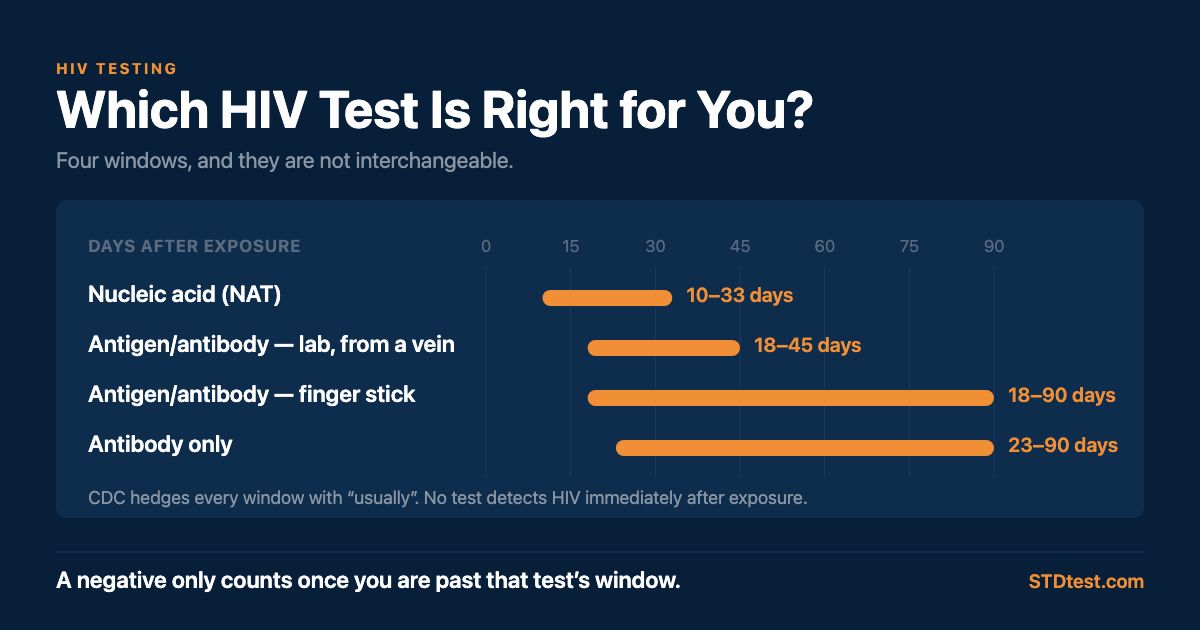
HIV test detection windows in days after exposure. Nucleic acid test 10 to 33 days. Antigen/antibody lab test on blood from a vein, 18 to 45 days. Antigen/antibody rapid test on a finger stick, 18 to 90 days. Antibody-only test, 23 to 90 days. CDC hedges every window with the word usually, and no test detects HIV immediately after exposure. A negative only counts once you are past that test's window.

Which HIV Test Is Right for You? Types Accuracy and What to Expect

There are several types of HIV tests available, and each one works a little differently. Some detect the virus itself, some detect your body’s response to it, and some do both. Understanding how each type works — and when it’s accurate — makes it easier to choose the one that fits your situation. All HIV
March 15, 2026
Read more
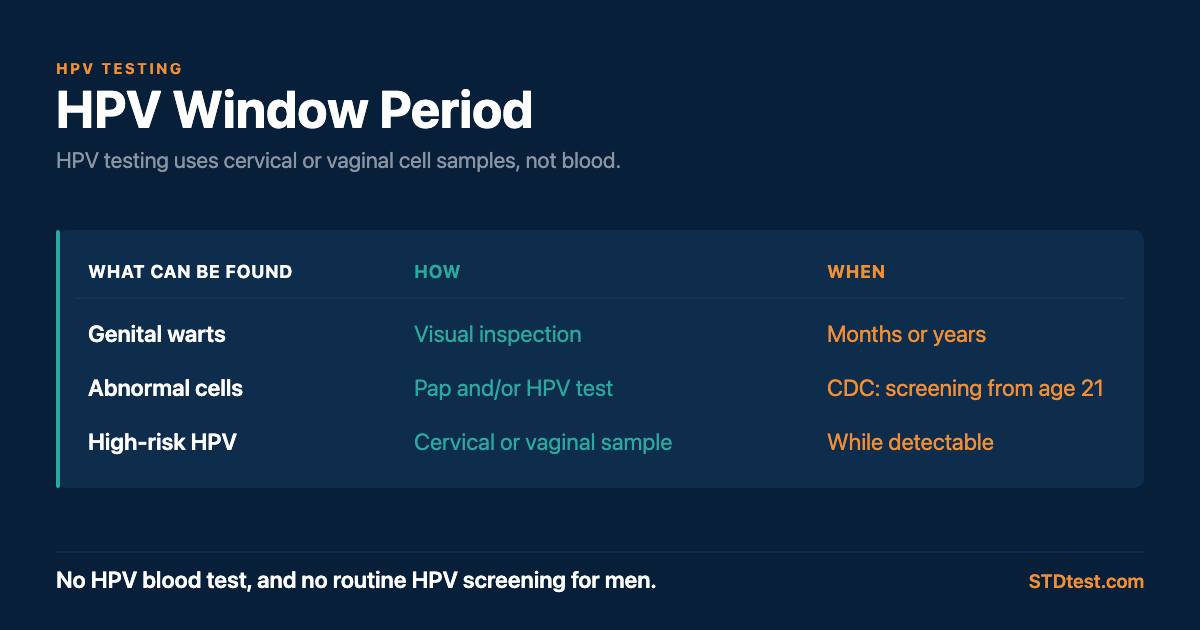
How HPV is detected. Genital warts, by visual inspection, developing months or years after exposure. Abnormal cervical cells, by Pap and/or HPV test, with CDC recommending screening from age 21. High-risk HPV, from a cervical or self-collected vaginal sample, while detectable. There is no HPV blood test and no routine HPV screening for men.

HPV Window Period: How Long Does HPV Take to Show Up?

The HPV window period isn’t quite like the window periods for other STIs. There’s no set number of days after exposure where a single test confirms or rules out infection. Understanding how HPV detection actually works — and why timing is more complicated than it sounds — can help you figure out the right approach
March 15, 2026
Read more
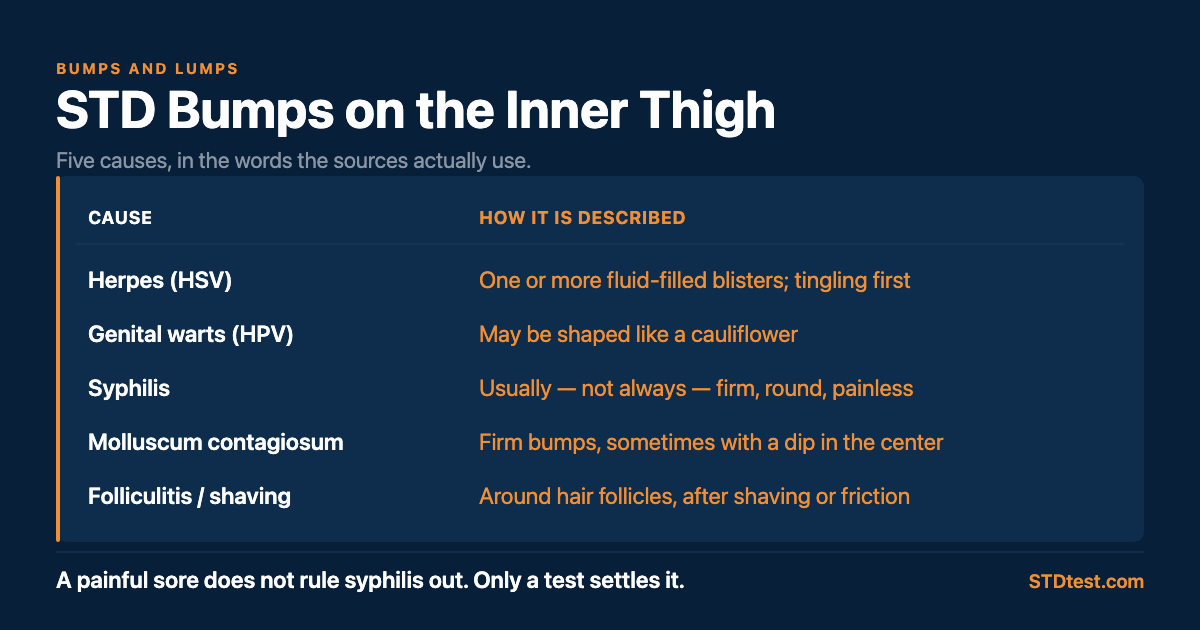
Causes of inner-thigh bumps as the sources describe them. Herpes: one or more fluid-filled blisters, with tingling first. Genital warts: may be shaped like a cauliflower. Syphilis: usually, but not always, firm, round and painless. Molluscum contagiosum: firm bumps, sometimes with a dip in the center. Folliculitis or shaving bumps: around hair follicles after shaving or friction. A painful sore does not rule syphilis out; only a test settles it.

STD Bumps on Inner Thigh: Causes & What to Do

STD bumps on the inner thigh are more common than many people realize, and noticing something new in that area can feel unsettling. The inner thigh sits close to the genitals, which means several sexually transmitted infections can produce bumps or rashes there. Understanding what might be causing them is a helpful first step toward
March 15, 2026
Read more
std rash

STD Rash: What It Looks Like & What to Do

An STD rash is a skin change — a bump, blister, sore, or flat discolored patch — that appears as a result of a sexually transmitted infection. These rashes can show up in the genital area, around the mouth, on the palms, the soles of the feet, or across the body. Knowing what to look
March 12, 2026
Read more

STD Sores: Types, Locations & When to Get Tested

STD sores are one of the most common reasons people look into getting tested. They can appear as blisters, open ulcers, firm bumps, or soft sores — and they show up in places like the genitals, anus, inner thighs, and mouth. Understanding what different types of sores look like, where they tend to appear, and
March 12, 2026
Read more
uti vs std

UTI vs STD: How to Tell the Difference

UTI vs STD — it’s one of the more common questions people have when something feels off down there. Both conditions can cause a burning sensation when you pee, and that overlap makes it genuinely hard to know which one you’re dealing with. Understanding the key differences can help you figure out what kind of
March 12, 2026
Read more
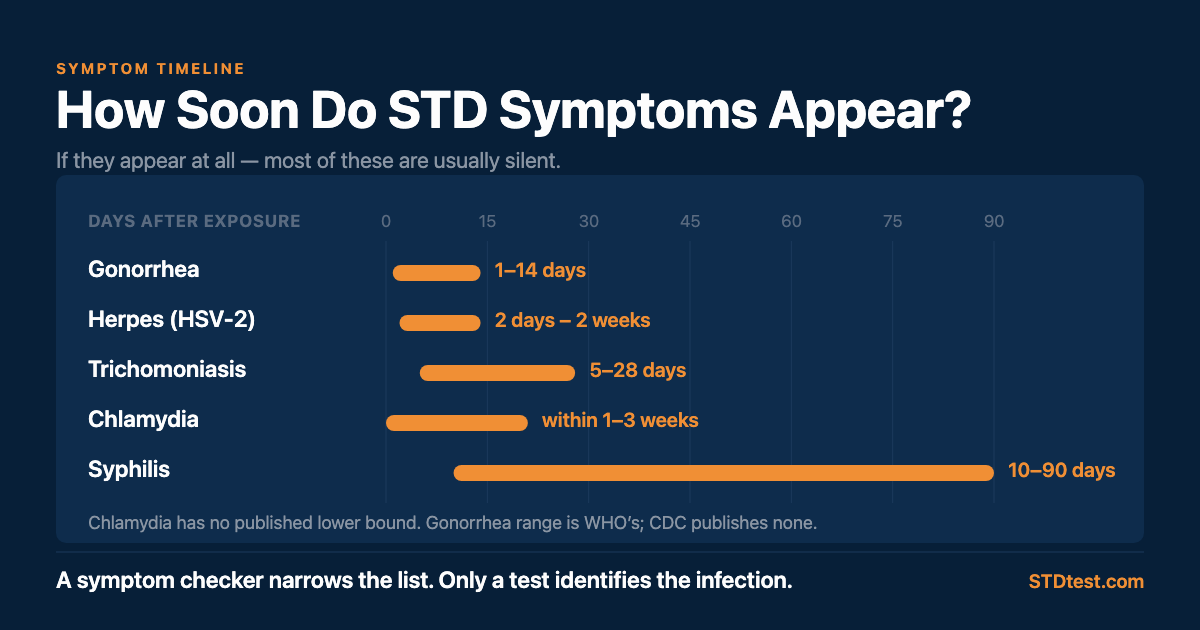
Days after exposure for symptoms to appear, if they appear at all. Gonorrhea 1 to 14 days per WHO. Herpes HSV-2, 2 days to 2 weeks. Trichomoniasis 5 to 28 days. Chlamydia within 1 to 3 weeks, with no published lower bound. Syphilis 10 to 90 days. A symptom checker narrows the list; only a test identifies the infection.

STD Symptom Checker: What Your Symptoms Could Mean

An STD symptom checker helps you understand what your body might be telling you. If you’ve noticed something unfamiliar — a sore, unusual discharge, or an itch that won’t go away — it’s natural to want answers. This page walks you through common STD symptoms, what they might point to, and when testing gives you
March 12, 2026
Read more
Previous Next

Confidential, Private and Affordable STD Testing?

Order a full 10 test STD screening panel now for just $139.
Individual STD tests starting at just $24.

Advertising Disclaimer

We connect users with trusted third-party testing providers, but do not offer medical advice, diagnosis, or treatment ourselves. Compensation may be received for some referrals.


All medical decisions should be made in consultation with a licensed healthcare provider.